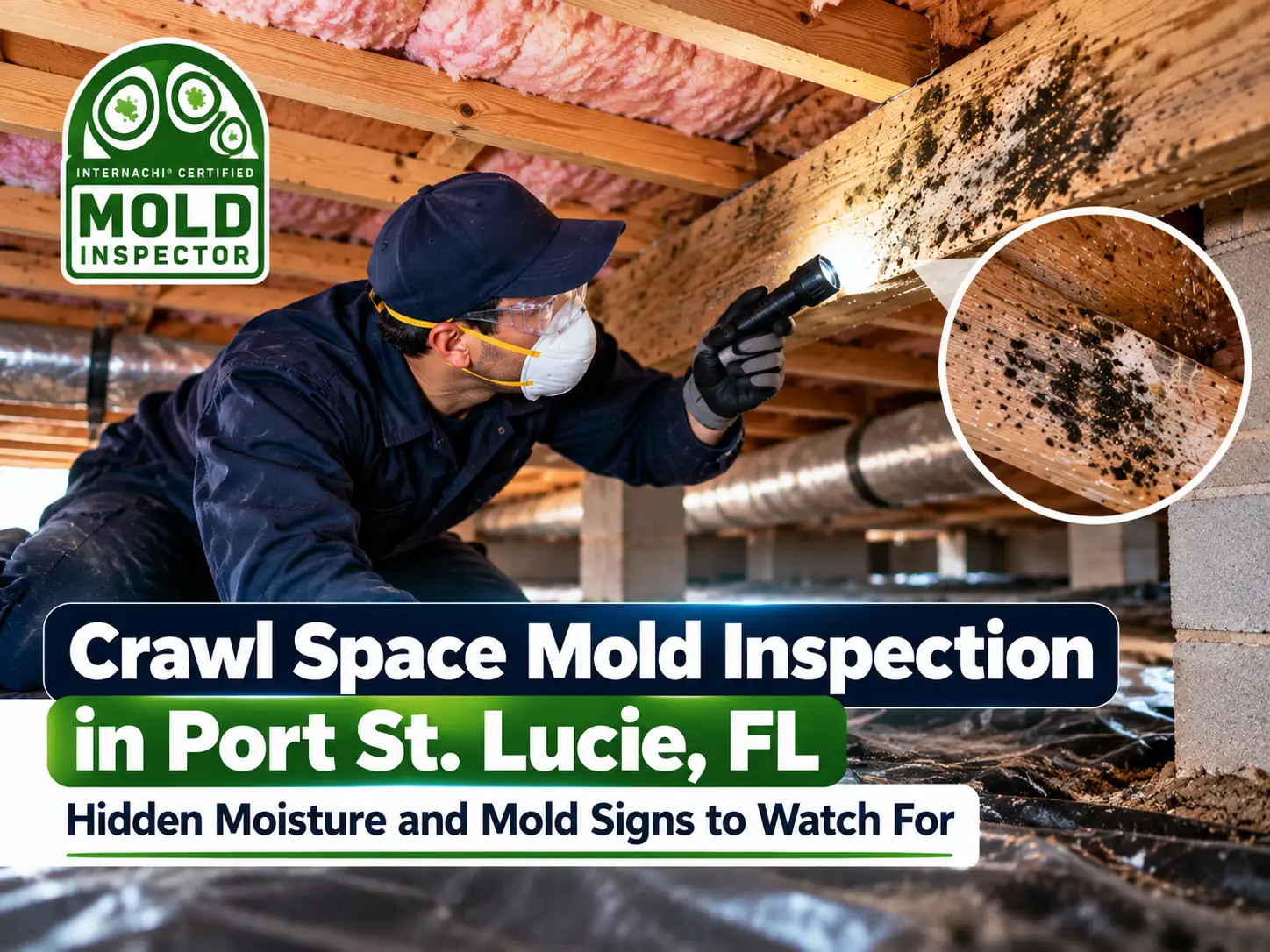
The space under a house is the part of a property nobody sees, which is exactly why moisture problems there can run for months. A damp crawl space can feed mold under the house, weaken wood framing, and send a musty smell up through the floors long before anything shows in the living area. A crawl space mold inspection in Port St. Lucie, FL is a way to find out what the air, the soil, and the wood down there are actually doing.
This guide covers why crawl spaces collect moisture, the signs worth watching for, what a professional crawl space moisture inspection involves, what homeowners can safely check on their own, and what to do once a problem is found.
Why Crawl Spaces Hold Moisture
Mold needs moisture, a food source, and time. A crawl space supplies the food in abundance: wood framing, floor joists, subfloor, paper-faced insulation, and stored cardboard are all organic materials. Moisture comes from several directions at once:
- Soil moisture. Exposed dirt releases water vapor into the space above it. Extension and Department of Energy guidance both treat bare soil without a plastic vapor barrier as a moisture entry route.
- Plumbing leaks. Supply lines, drain pipes, and water heater or fixture connections run through the space, and a slow drip can go unseen.
- Water intrusion. Rain that pools near the foundation, poor grading, and gutters that discharge too close to the house can send water into the space. Extension guidance suggests downspouts that discharge 6 to 10 feet from the foundation.
- Condensation. Warm, humid air meeting cooler surfaces such as ducts and pipes leaves moisture on them.
- Poor ventilation. Humid outdoor air entering through foundation vents can add moisture rather than remove it, especially in a humid climate.
The EPA advises drying wet building materials within 24 to 48 hours to prevent mold growth. A crawl space rarely dries that fast on its own, so a small, steady source can keep materials damp for weeks.
Does Every Port St. Lucie Home Have a Crawl Space?
No. Some homes are built on concrete slabs and have no space underneath at all. Crawl spaces are found in raised or pier-built homes, some older houses, and some additions. Checking the foundation type is the first step, since a home on a slab has no crawl space to inspect, though slab homes can still have moisture problems of their own that call for a different kind of inspection.
Signs of Hidden Mold and Moisture Under a House
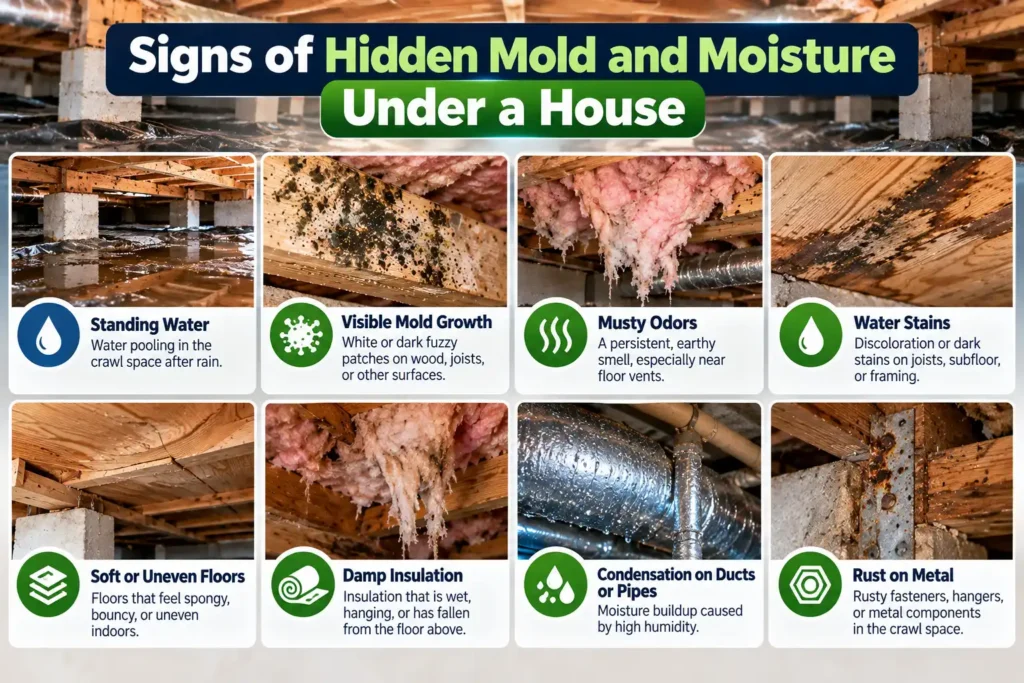
A crawl space problem usually shows up in the living space before anyone looks underneath. Watch for:
- A musty smell that is stronger near floor vents, closets on exterior walls, or the lowest rooms
- Floors that feel soft, spongy, bouncy, or uneven
- Cupping or buckling of wood flooring, or gaps opening between boards
- Damp insulation hanging from the floor above, or insulation that has fallen
- Visible growth, white or dark fuzzy patches, or staining on floor joists and framing
- Standing water or damp soil after rain
- Condensation on ducts or pipes
- Rust on fasteners and metal, or a rising indoor humidity level that doesn’t match the weather
Several of these together point strongly to a moisture problem, but none of them alone confirms mold. Many things can cause a smell or a soft spot, which is why confirming the moisture source matters more than naming the growth.
How Humidity Affects a Crawl Space
Crawl space humidity is one of the more useful numbers to track. Extension guidance recommends keeping indoor humidity below 60 percent, and the EPA’s recommended range is 30 to 60 percent. In a humid coastal climate, a crawl space connected to outdoor air through vents can sit above that range for long stretches, particularly in summer.
Wood moisture matters too. Department of Energy guidance describes a wood moisture content of 20 percent or higher as a reasonable level for concern. Humidity in the air and moisture inside the wood aren’t the same measurement, and neither one alone tells the whole story. A leak can wet a surface even when the air reading looks normal, which is why inspectors use both a hygrometer and a moisture meter and compare the results.
What a Crawl Space Mold Inspection Involves
A professional inspection combines observation with measurement:
- Visual assessment. The inspector looks over the framing, subfloor, insulation, soil, vapor barrier, vents, and plumbing for visible growth, staining, damage, and signs of past water.
- Moisture readings. A moisture meter checks the moisture content of the wood, and humidity readings show the condition of the air in the space.
- Source tracing. Leaks, grading problems, drainage issues, and condensation points are checked as likely causes.
- Air sampling. When mold is suspected but not clearly visible, air samples may be taken and compared with an outdoor sample.
- Surface sampling. A swab or tape sample from visible growth can identify the type of mold.
- Laboratory analysis and report. Samples go to a lab, and findings, photographs, readings, and recommendations are written up.
Mold Detectives Florida lists these steps on its crawl space mold inspection and testing including moisture and humidity testing, air and surface sampling, laboratory analysis, and a written report with recommendations.
Sampling is a tool for answering a specific question, not an automatic step. When mold is already visible, sampling is often unnecessary to confirm it, and the EPA has no federal limits for mold or mold spores, so lab numbers are read together with the visual and moisture findings.
What Homeowners Can Check Safely
Crawl spaces have low clearance, sharp edges, exposed wiring, pests, and mold that is easy to stir up. Most of what a homeowner can do safely happens at the surface:
- Look from the access opening with a flashlight rather than crawling in.
- Check that downspouts discharge well away from the foundation and the soil slopes away from the house.
- Look under sinks and around the water heater for dampness and leaks.
- Watch the water meter. If it moves when everything is off, a leak may be running under the house.
- Note smells, soft spots, and humidity patterns, and photograph anything visible.
People with allergies, asthma, or a weakened immune system should leave disturbed or suspected mold to a professional. If a plumbing leak is suspected, leak detection can trace the source before anything else is done.
What to Do After Moisture or Mold Is Found
The order matters:
- Stop the source first. Drying a space that is still being fed accomplishes nothing.
- Dry quickly. Fans and dehumidifiers help, and saturated insulation or damaged materials may need to be removed.
- Fix the conditions. Common fixes include repairing leaks, correcting grading and drainage, and adding a vapor barrier over exposed soil. Extension guidance treats a plastic vapor barrier over the soil as a minimum.
- Plan for remediation if needed. If mold has to be removed, ask how the work will be separated from the assessment. Under Florida law, a licensed mold assessor generally can’t also remediate the same property within 12 months, with a narrow exception for certain contractors.
- Confirm the result. A follow-up check shows whether the space is dry and whether the problem is resolved.
Closing up or covering a damp crawl space without fixing the cause can trap moisture and make the problem worse.
Port St. Lucie Conditions That Raise the Stakes
Port St. Lucie is in St. Lucie County on Florida’s Atlantic side, where warm, humid weather and the June through November hurricane season keep moisture pressure high. Heavy rain and storm flooding can leave water pooled around foundations, while humid air slows drying afterward. Air conditioning runs for much of the year, so ducts and pipes under a raised home can sweat constantly.
Mold Detectives Florida also has a guide to the common mold problems found during Port St. Lucie home inspections, which covers what inspectors tend to find around the area’s homes.
Choosing a Crawl Space Mold Inspector
Ask a few questions before booking:
- Does the inspector physically enter the crawl space, and how is the space assessed?
- What tools are used for moisture and humidity readings, and how are the findings confirmed?
- When is sampling recommended, and why?
- What will the written report include?
- Does the company assess only, or also remediate, and how is any conflict of interest handled?
- What licenses does the company hold? Florida requires a license for mold assessors, and the number can be checked with the state.
Mold Detectives Florida serves Port St. Lucie and other parts of Florida, and its mold inspection and crawl space services are listed on its site.
Questions Homeowners Ask About Crawl Space Mold
Is mold in a crawl space dangerous?
It can be a concern for indoor air, since air moves from the space under a house into the living area. Mold also feeds on wood and can contribute to damage over time. How much it affects a particular home depends on how much growth there is and where the moisture is coming from.
Can a crawl space be tested without crawling in?
Looking from the access opening reveals some things, but a proper assessment usually requires entering the space to check framing, soil, plumbing, and insulation, and to take readings at several points.
Do all crawl spaces need a vapor barrier?
Extension guidance describes a plastic vapor barrier over exposed soil as a minimum. Whether a specific crawl space needs more depends on its condition, drainage, and ventilation, which an inspection can help clarify.
Find the Moisture Before It Reaches the Wood
A musty floor, a soft spot, or damp insulation under the house are all worth looking into early. If something seems off in a Port St. Lucie home, Contact Mold Detectives or call (772) 242-4024 to talk through what is being noticed.