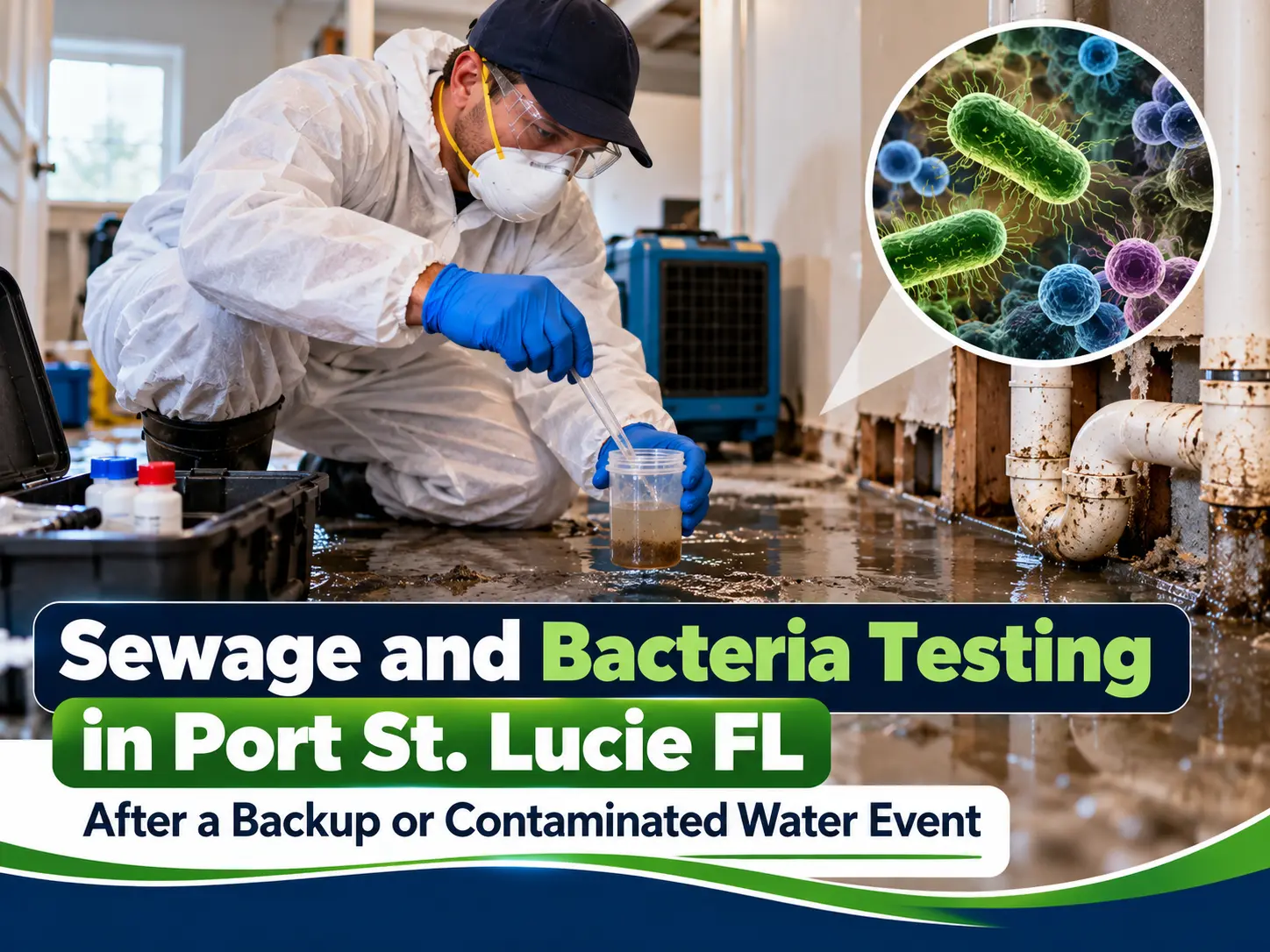
A sewage backup is one of the few household water problems where the smell is the least of the concern. Wastewater can carry bacteria, viruses, and other germs into flooring, drywall, and cabinetry, and what soaks in doesn’t always come out with a mop. Sewage and bacteria testing in Port St. Lucie, FL is one way to find out how far contamination spread, document conditions, and confirm that cleanup worked, though it is only one part of a larger response.
This guide covers what to do first after a backup, how to recognize sewage contamination, which materials can be saved, when bacteria testing after a sewage backup is worth doing, what a professional inspection includes, and what results can and can’t tell you.
Why a Sewage Backup Is More Than a Cleanup Problem
Sewage can carry bacteria, viruses, and other germs. Health agencies note that the most common illnesses from exposure are stomach illness and skin rashes or infections, and that the risk depends on how much sewage was involved, how long it stayed in contact with materials, and how long a person was exposed. People who develop nausea, vomiting, or diarrhea after exposure should contact a doctor.
Time matters. The longer wastewater intrusion sits in a building, the more it soaks into porous materials, and the more likely moisture damage and mold become. That is why speed, protective gear, and a clear order of steps count for more than any single product or test.
What to Do First After a Sewage Backup
Health departments and sewer agencies give consistent advice for the first hours:
- Stop adding water. Avoid flushing toilets or running drains while a backup is active.
- Keep people and pets away from the affected area, especially children.
- Turn off power to affected areas if there is standing water or wiring may be near it, and only if doing so is safe.
- Find the source. If the backup comes from a main sewer line, contact the sewer utility. If the property uses a septic system, contact a septic contractor or the county health department. A plumber can check household drain lines.
- Call the insurance company early, since some policies come with approved cleanup companies, and what a policy covers is a question for the insurer.
- Photograph everything before anything is moved or cleaned.
- Wear protective gear such as rubber gloves, eye protection, and waterproof boots if any cleanup begins, and wash hands thoroughly afterward.
If sewage has sat indoors for more than a day in a finished living space, or if it may have reached ductwork, professional help is usually the safer route.
Signs of Sewage or Contaminated Water in a Home
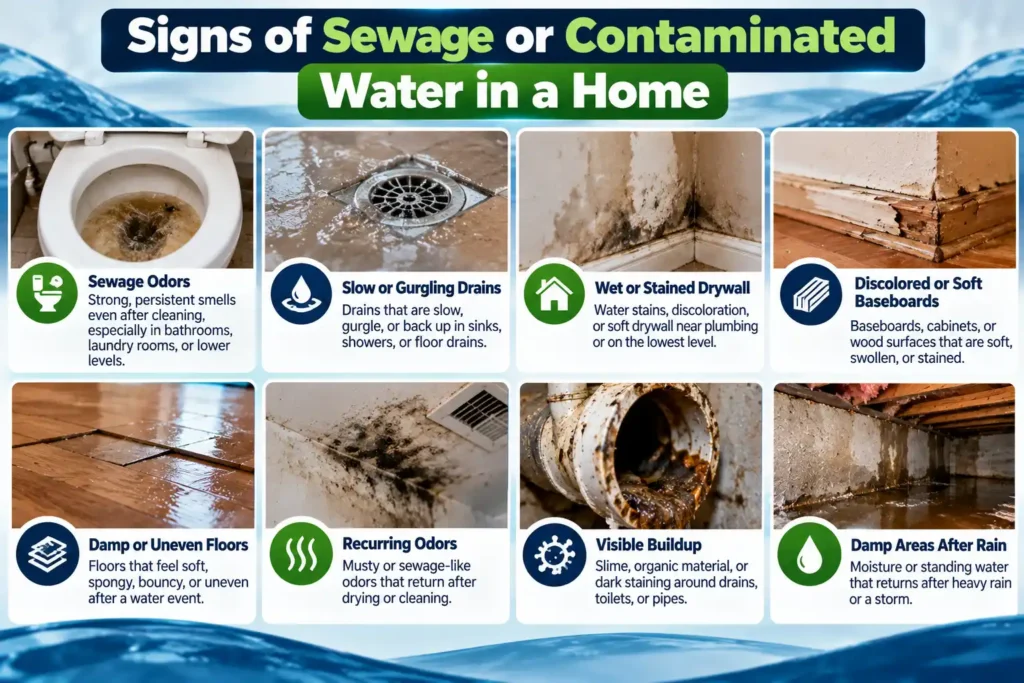
Not every contamination event is as obvious as an overflowing toilet. Signs worth taking seriously include:
- Sewage odors that linger after cleaning, especially in a bathroom, laundry room, or the lowest part of the house
- Slow drains, gurgling fixtures, or water backing up in a shower or floor drain
- Wet or stained drywall and flooring near plumbing or at the lowest level
- Discolored or soft baseboards and cabinet bases
- Damp areas that return after drying
- Recurring odors after a storm or heavy rain
- Visible organic buildup, slime, or dark staining around drains
These signs call for finding the source first. Odors can come from a dry trap or a vent problem rather than contamination, so confirming the cause matters before assuming the worst.
Which Materials Can Be Cleaned and Which Usually Go
Cleanup guidance from health agencies draws a line between hard and porous materials.
Usually discarded: carpet and carpet padding, upholstered furniture, mattresses and pillows, cardboard, paper and books, stuffed toys, unfinished wood, and wallboard that has absorbed contaminated water. Wallboard with a water line is typically cut out several inches above that line and replaced.
Often cleaned and disinfected: tile, ceramic, sealed wood, glass, and other hard, non-porous surfaces, once they have been cleaned with detergent, disinfected, and fully dried.
Cleaning comes before disinfecting, because disinfectant doesn’t work well on dirty surfaces. Product labels set the right dilution and contact time, and bleach should never be mixed with ammonia-based products, since the mix releases dangerous gas. Dry the space quickly, because areas that stay wet for more than 24 to 48 hours carry a higher risk of mold.
When Bacteria Testing Makes Sense
Public health guidance on sewage backups focuses on cleanup, drying, and disinfection. It doesn’t generally call for testing as a routine step, and testing never replaces removal of affected materials. Still, there are situations where testing and a contamination assessment are useful:
- The extent of contamination is unclear, such as after a backup that spread under flooring or into wall cavities
- The backup may have reached ductwork or an area that is hard to see
- Odors or moisture return after cleanup
- Occupants, tenants, or a property manager want documented cleanup verification
- A landlord, tenant, or insurer needs a written record of conditions
- A private well or plumbing fixtures may have been affected
Testing answers specific questions. It doesn’t decide what has to be thrown away, and it isn’t a substitute for professional cleanup when the situation calls for one.
What Sewage and Bacteria Testing Involves
A professional assessment starts with observation, then adds measurement:
- Visual and moisture assessment. The inspector documents affected areas, materials, and the likely path of the water, and checks moisture levels in walls and floors.
- Environmental sampling. Depending on the situation, surface swabs or water samples may be collected from affected areas, fixtures, or plumbing points.
- Laboratory analysis. Samples go to a lab, which looks for indicator organisms such as coliform bacteria or E. coli, depending on the test requested.
- Written report. Findings, sampling points, and recommendations are documented.
Mold Detectives Florida describes its sewage and bacteria testing as covering E. coli and fecal coliform, coliform levels, cross-connection checks using dye testing and pressure evaluation, and biofilm detection, with analysis by a laboratory. The service page describes testing rather than cleanup, so testing works best as the assessment step alongside a cleanup company or plumber.
What Test Results Can and Can’t Tell You
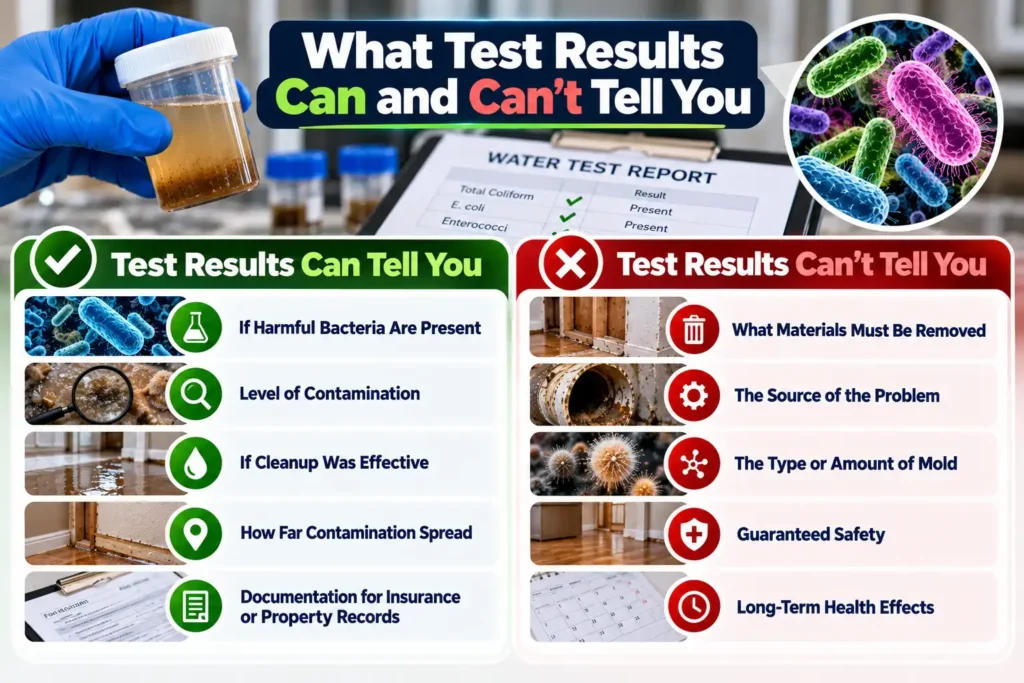
Results are useful but easy to over-read:
- A positive result shows that a target organism was present at that spot on that day. It doesn’t measure how sick anyone might get.
- A negative result doesn’t prove an area is clean everywhere. A sample only represents the spot it came from.
- Homes don’t have a single universal pass-or-fail standard for surface bacteria, so results are read alongside the visual findings, moisture readings, and cleanup history.
- Testing before cleanup shows what was there. Testing after cleanup shows whether sampled areas are free of the targeted organisms at that moment.
For that reason, the sampling plan matters as much as the result. A good inspector explains where samples will be taken and what question each one answers.
Mold After a Backup
A sewage event is also a water event. Materials that stay wet can support mold within a day or two, so a contamination problem often becomes a mold problem if drying is slow. A Mold Detectives Florida guide explains how quickly mold can grow after water damage in Florida, which is useful for judging how urgent drying is. Moisture readings during or after cleanup help show whether walls and floors are actually dry before they are closed up or replaced.
Port St. Lucie Conditions That Raise the Risk
Port St. Lucie is in St. Lucie County on Florida’s Atlantic side, where heavy summer rain, tropical storms, and the June through November hurricane season can overwhelm drainage and strain sewer systems and septic drain fields. Some properties are on city sewer and others on septic, which changes who to call and where the problem may start. Warm, humid air also slows drying afterward, which leaves cleaned areas damp longer than in a drier climate.
When contaminated water may have reached a private well, sinks, or a water heater, water testing can help show whether those parts of the system were affected.
Choosing a Testing Provider
Before booking, ask a few questions:
- What will be sampled, where, and why?
- Which organisms does the lab test for?
- Which lab is used, and how long do results take?
- What will the report contain?
- Does the company assess only, or also clean up, and how is any conflict of interest handled?
- What licenses does the company hold, and can the numbers be checked?
Mold Detectives Florida serves Port St. Lucie and other parts of Florida, and its sewage and bacteria testing is listed on its site.
Questions Homeowners Ask About Sewage Testing
Do I need testing after every sewage backup?
Not always. Prompt removal of contaminated materials, cleaning, disinfection, and drying are the core steps. Testing is most useful when the spread is unclear, odors return, or documentation is needed.
Can I clean up a sewage backup myself?
Small backups on hard surfaces can sometimes be handled with protective gear and proper cleaning, but larger events, sewage that reached ductwork, or backups lasting more than a day indoors usually call for professional help.
How long do lab results take?
It depends on the type of test. Mold Detectives Florida says laboratory results for water testing are usually available within a few days.
Get Clear Answers After a Contaminated Water Event
A backup is stressful enough without wondering what is left behind. If a sewage or contaminated water event has affected a Port St. Lucie home or property, Contact Mold Detectives or call (772) 242-4024 to talk through what happened.