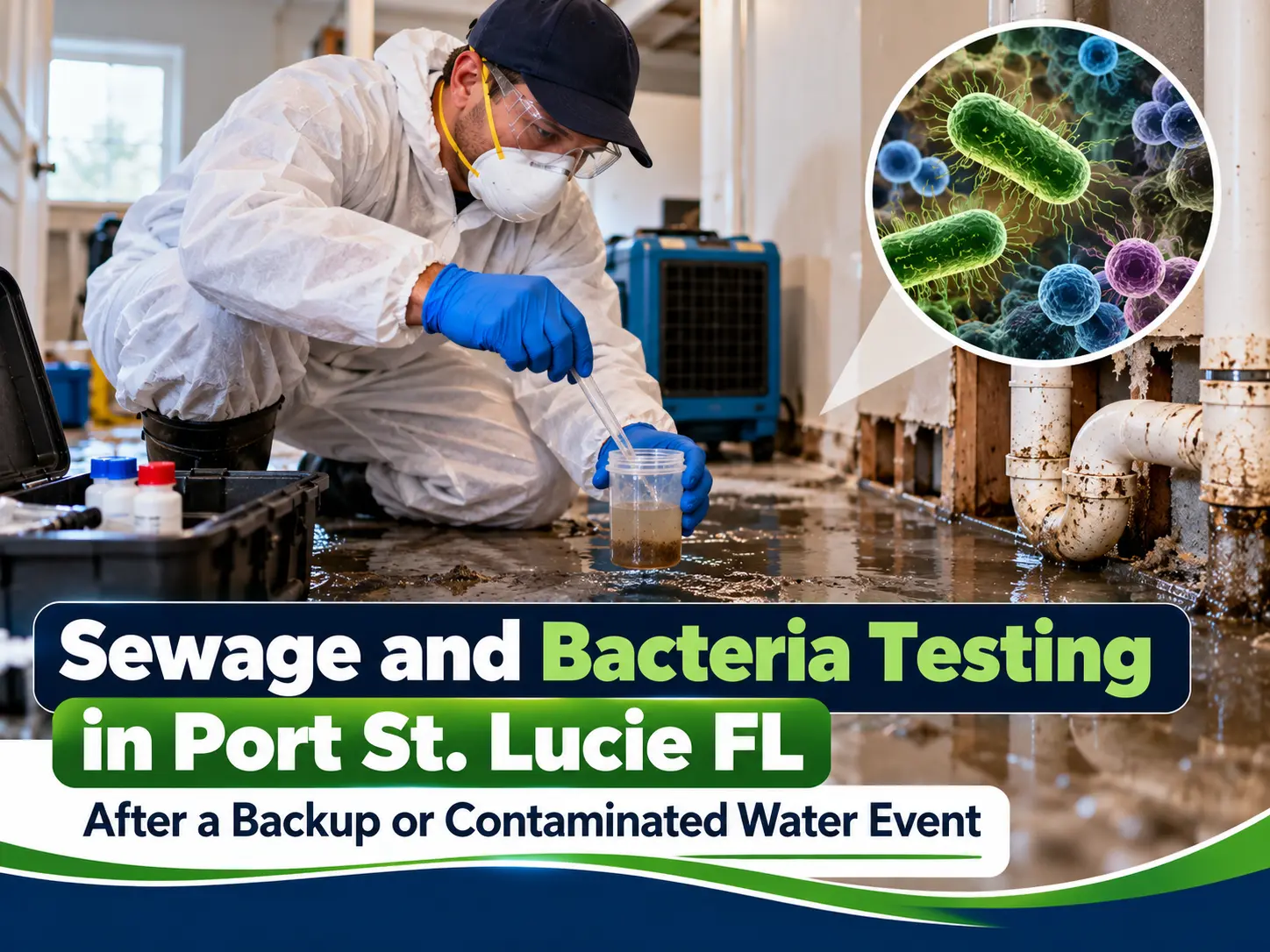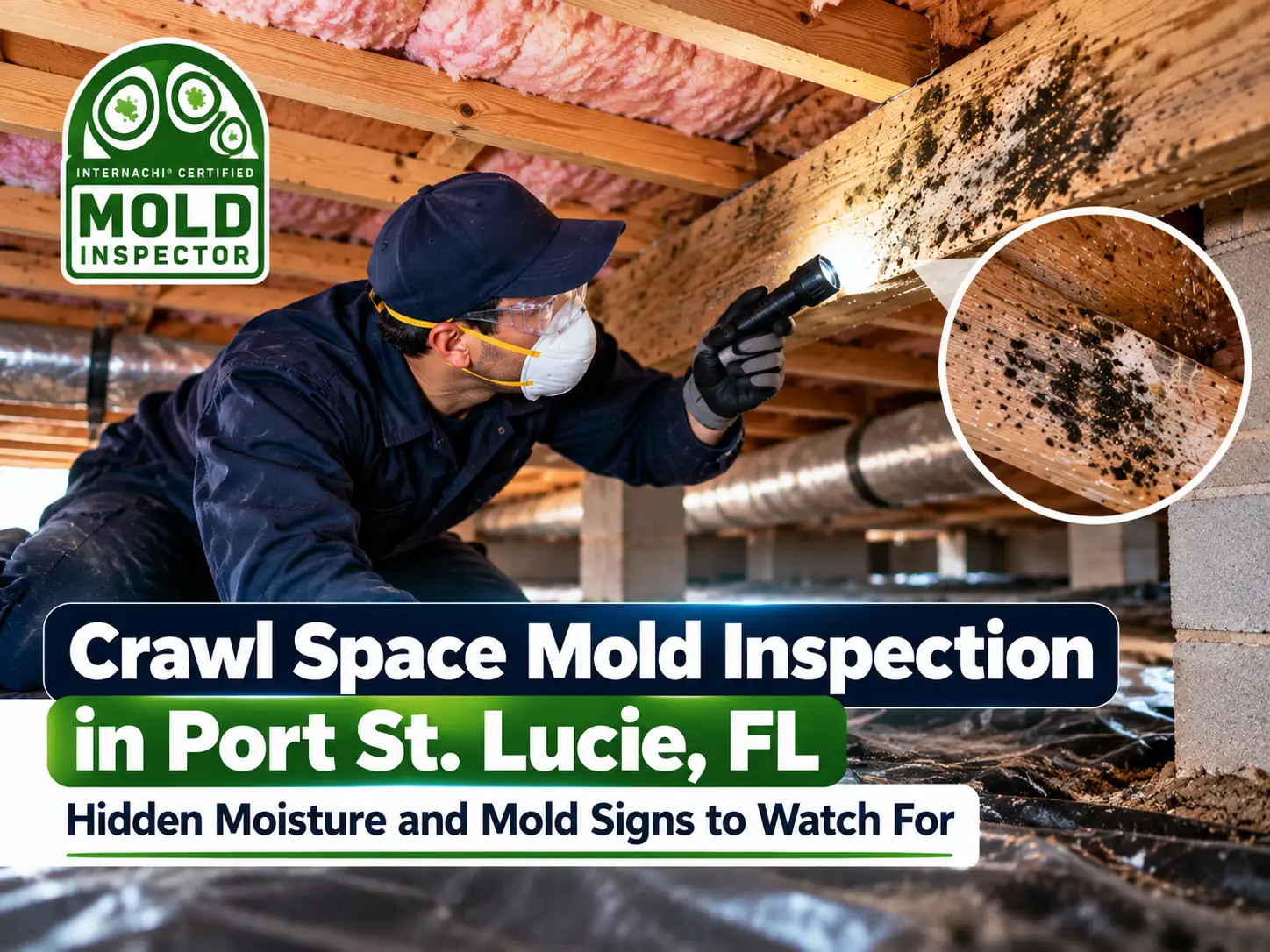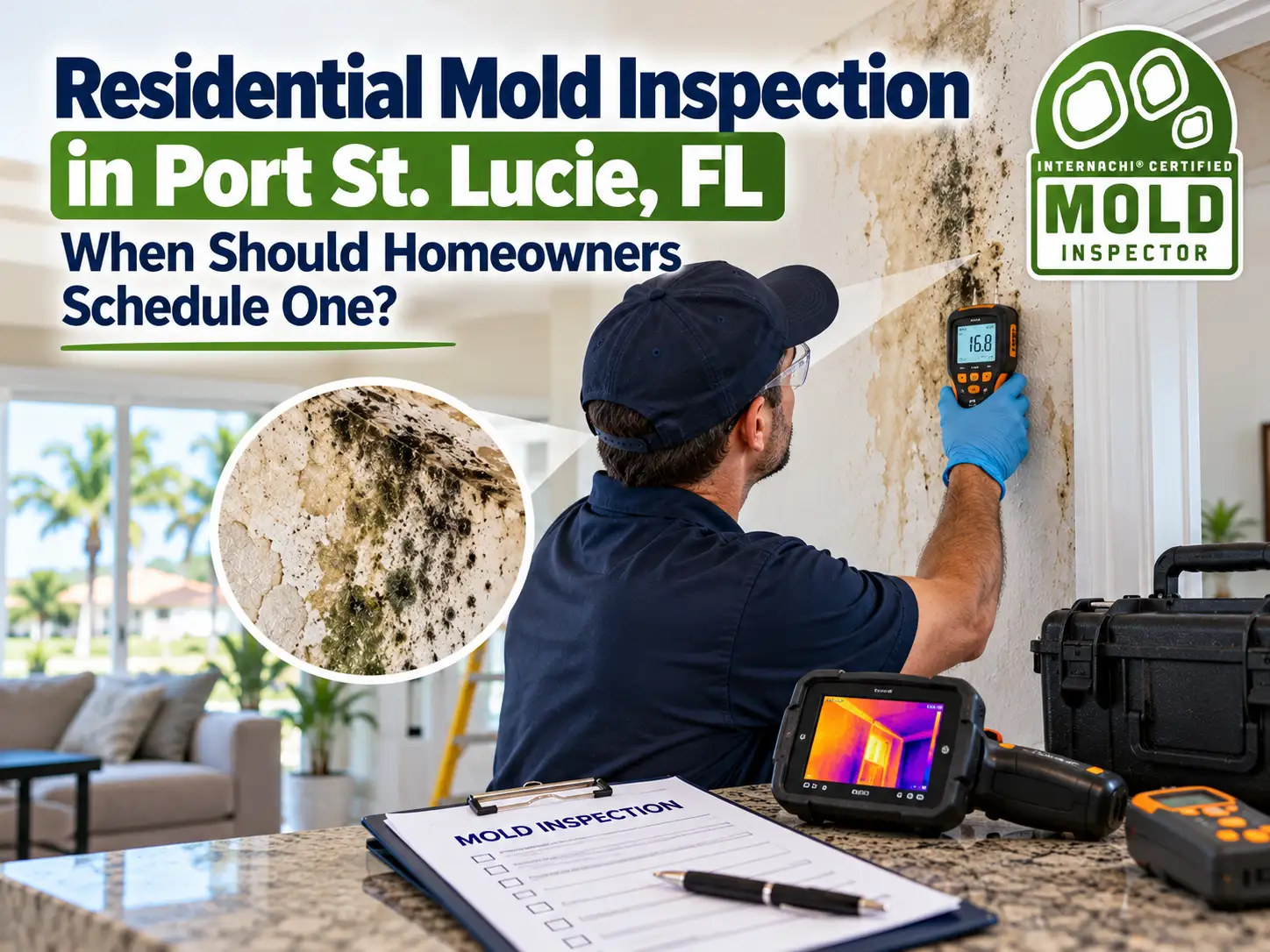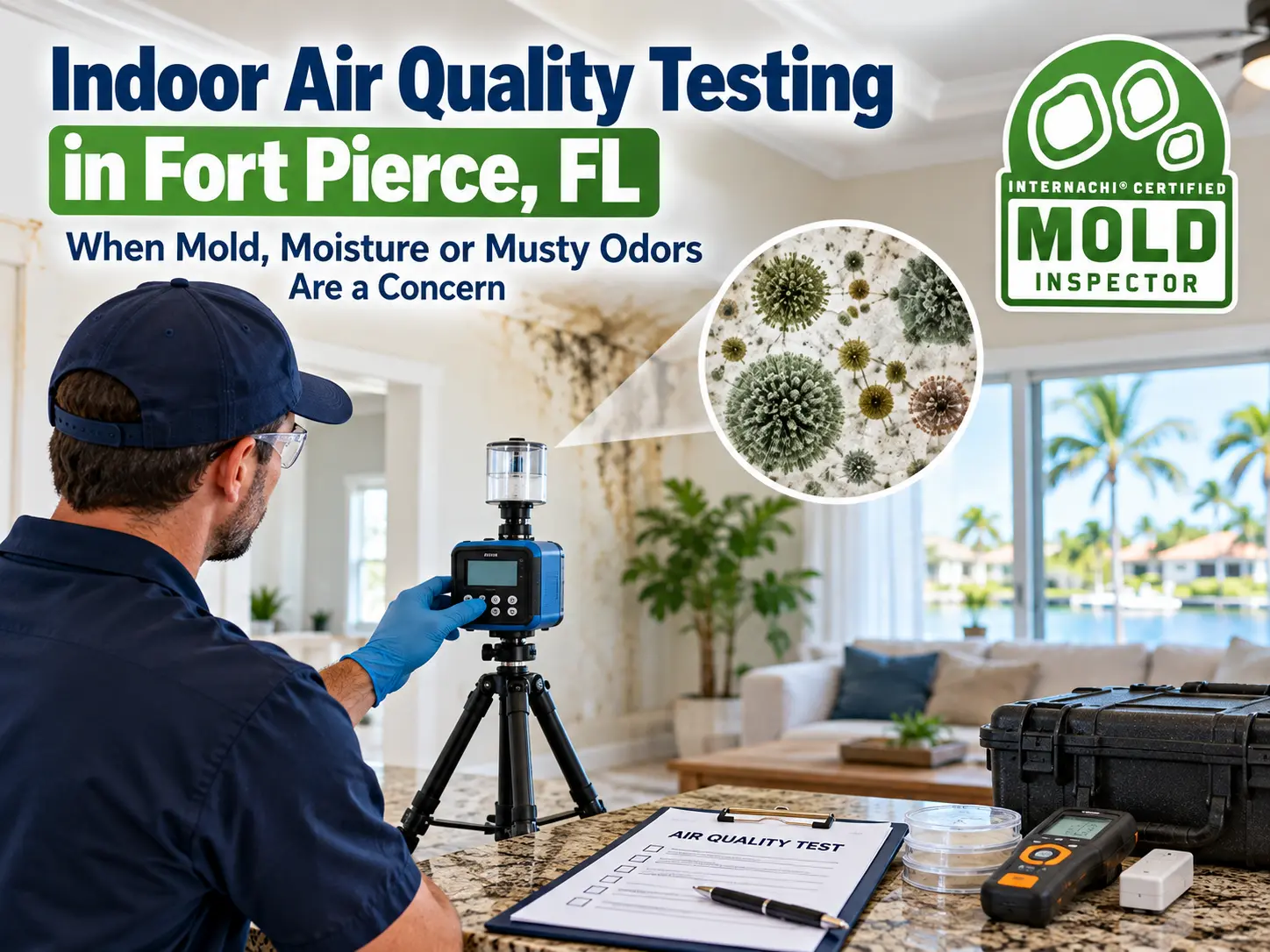
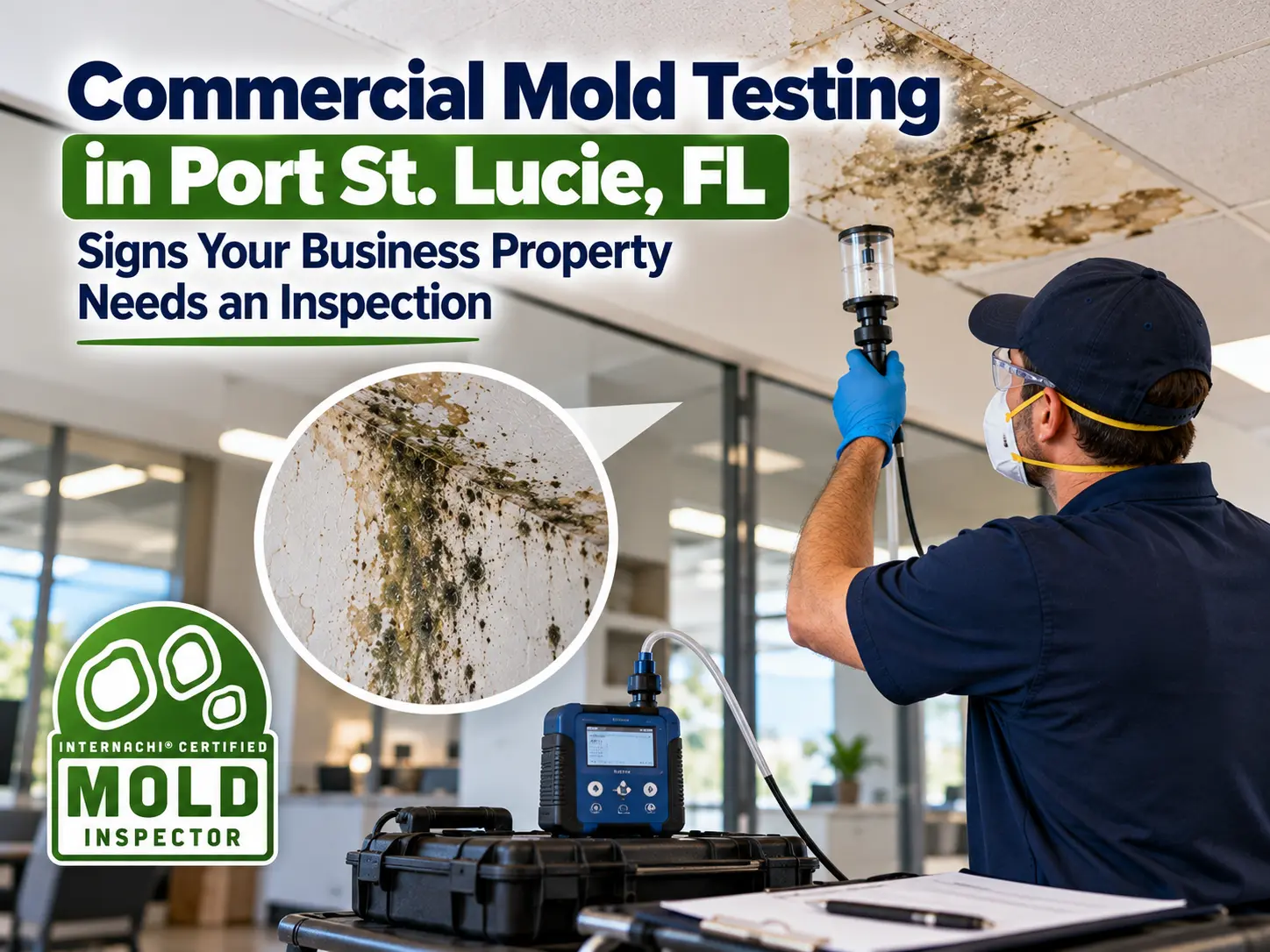
A musty smell in the break room that returns every week. A ceiling tile that keeps picking up a brown ring. Employees who say the same suite “feels off.” Problems like these are easy to dismiss in a busy building, and that is how a small moisture issue turns into a larger one. Commercial mold testing in Port St. Lucie, FL is how business owners, landlords, and property managers find out what is actually happening behind the surfaces.
This guide covers the signs that point to a moisture or mold problem, where hidden moisture tends to collect in commercial buildings, what a professional commercial mold inspection includes, what test results can and can’t tell you, and what to do before and after an inspection.
Why Commercial Properties Face Different Mold Risks
Mold needs moisture, a food source, and time. Offices, retail spaces, and warehouses supply plenty of food in the form of drywall, ceiling tiles, wood, carpet, and stored cardboard. What decides whether mold grows is water. The U.S. Environmental Protection Agency advises drying wet building materials within 24 to 48 hours and fixing the source of the moisture, because controlling moisture is the only reliable way to control mold indoors.
Commercial buildings add complications that a house doesn’t have. Large footprints make a slow leak harder to spot. Shared HVAC systems can carry moisture and odors from one area to another. Suites sit empty over weekends or between tenants, so a leak can run unnoticed. Space above drop ceilings is rarely checked. Many commercial roofs are flat or low-slope, which makes drainage and flashing details especially important. A building mold inspection has to account for all of that, not just the one room where the complaint started.
Signs Your Business Property Needs a Mold Inspection
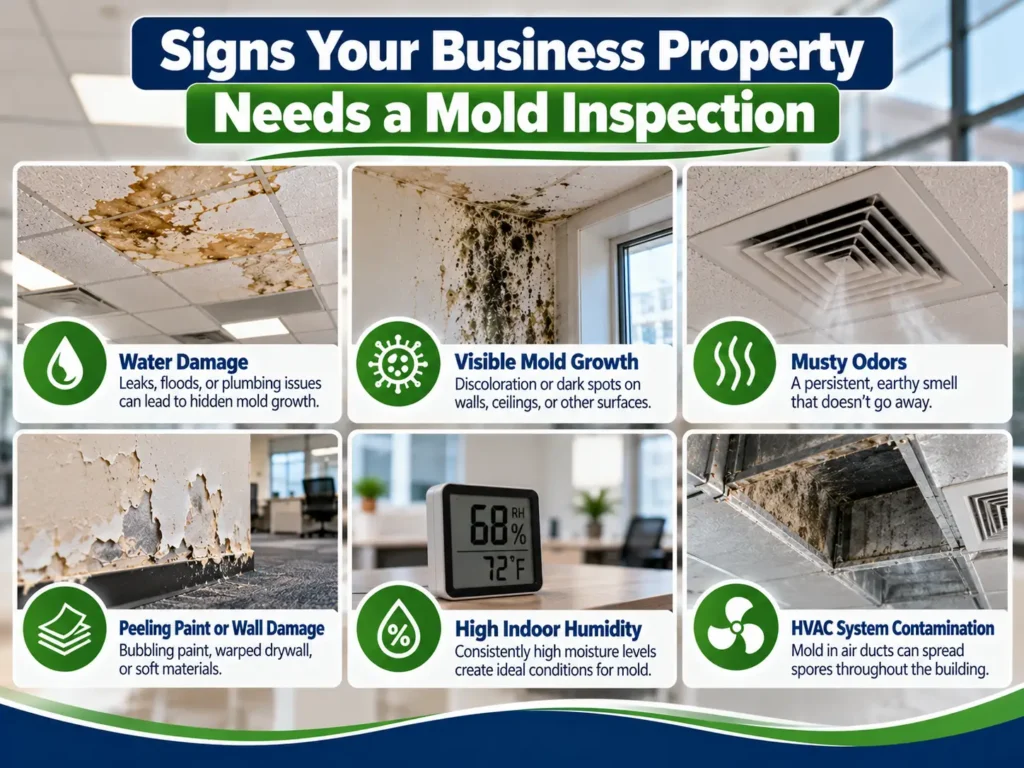
No single sign proves mold, but several of these together, or any of them repeating, justify a closer look:
- Persistent musty odors. A smell that returns after cleaning usually means moisture is still present somewhere nearby.
- Recurring stains or damp materials. Ceiling stains that spread, wall paint that bubbles or peels, soft drywall, and warped flooring all point to water movement.
- Visible spots or surface changes. Fuzzy or discolored patches on walls, ceilings, window frames, or the backs of cabinets.
- Moisture around the HVAC system. Condensation at vents, stained ceiling tiles near diffusers, wet drain pans, or overflowing condensate lines.
- Repeated employee or tenant complaints. When several people report the same odor or discomfort in the same area, that pattern is worth documenting. Symptoms alone don’t confirm mold, since many things can cause them, but a consistent location helps narrow the search.
- A recent water event. A roof leak, burst pipe, storm intrusion, or sprinkler discharge where materials stayed wet for more than a day or two.
For a shorter checklist, this guide to the warning signs a commercial property needs mold testing walks through the most common ones.
Where Hidden Moisture Develops in Commercial Buildings
Hidden moisture is the reason a problem can exist for months without an obvious sign. Common locations include:
- Above drop ceilings, where roof or plumbing leaks soak insulation and tiles first
- Around rooftop HVAC units and along condensate drain lines
- Behind break room sinks, restroom fixtures, and cabinetry
- Inside wall cavities along exterior walls, window joints, and storefront glazing
- At the edges of slabs and under flooring in storage rooms and warehouse areas
- In vacant suites where the air conditioning has been turned off or turned up
A thermal imaging camera helps find these spots, but it has limits. It reads surface temperature differences, not water itself, so a cool patch is a lead that still needs to be confirmed with a moisture meter. Tracing the moisture back to its source matters more than any single reading.
What Commercial Mold Testing Involves
A professional inspection combines observation with measurement. The usual sequence looks like this:
- Visual walkthrough. The inspector looks for visible growth, water damage, stains, and odors, and asks about the building’s water history.
- Moisture readings. Moisture meters and thermal imaging help locate damp materials that can’t be seen.
- Air sampling. Samples may be collected to evaluate airborne particles such as mold spores, usually compared with an outdoor sample taken the same day.
- Surface sampling. Swab or tape samples may be taken from walls, ceilings, or HVAC components when visible growth or contamination is suspected.
- Laboratory analysis. Samples go to a lab, and the results are read alongside what was seen and measured on site.
- Written report. Findings, photographs, readings, and recommendations are documented.
Mold Detectives Florida describes its indoor air quality testing as covering offices, schools, and rental properties, with most tests taking two to four hours depending on property size and complexity. Sampling is a tool for answering a specific question, not an automatic step, and a good inspector explains why each sample is being taken.
What Mold Test Results Can and Can’t Tell You
Test results are easy to over-read. The EPA has no standards for airborne mold levels, and no federal limits exist for mold or mold spores in buildings. Spores are present indoors and outdoors all the time, so a result is not a simple pass or fail.
A few points keep results in perspective:
- Air samples are a snapshot. Spore counts shift with weather, time of day, door traffic, and HVAC operation.
- Indoor results mean the most when compared with an outdoor sample and with what the inspection found.
- When mold is already visible, sampling is often unnecessary to confirm it. The priority is finding the moisture source and the extent of the affected materials.
- Testing identifies and documents. It doesn’t remove mold or fix a leak.
The most useful part of an inspection is often the moisture map and the explanation of where the water is coming from, not the lab numbers.
Who Needs to Be Involved: Owners, Tenants, and Property Managers
Commercial buildings usually have several stakeholders, and an inspection goes more smoothly when each one knows its role.
A property manager or landlord often coordinates the inspection and the repairs. A tenant is usually the first to notice a problem and benefits from reporting it in writing, with dates, photos, and a description of the location. A business owner who owns the building carries both roles.
Who pays for what typically depends on the lease and on who owns the affected systems, so reviewing the lease, or asking an attorney, is the safest route. An inspection report gives everyone the same documented starting point for repairs, scheduling, and conversations with an insurer, although what a policy covers is a question for the insurance company.
Steps to Take Before and After an Inspection
Before the inspection:
- Stop or limit the water source if it is known and safe to do so.
- Record when odors, stains, or complaints started, and photograph affected areas.
- Avoid painting over or covering suspect areas, which hides evidence without fixing the cause.
- Ask the inspector how to prepare, since sampling conditions can affect results.
After the inspection:
- Fix the moisture source first. Remediation done while water is still entering the building won’t last.
- Dry wet materials quickly and replace those that can’t be dried, such as saturated ceiling tiles and insulation.
- If remediation is needed, ask how the work will be separated from the assessment. Under Florida law, a licensed mold assessor generally can’t also remediate the same property within 12 months, with a narrow exception for certain contractors, so the two roles are usually handled by different companies.
- Plan a follow-up check after remediation to confirm the area is dry and the problem is resolved.
Port St. Lucie Conditions That Affect Commercial Buildings
Port St. Lucie sits in St. Lucie County on Florida’s Atlantic side, where warm, humid weather and the June through November hurricane season make moisture a recurring concern. Storm-driven rain tests roofs, rooftop equipment, windows, and storefront seals. Air conditioning runs for much of the year, which keeps condensate lines, drain pans, and ductwork working constantly, and humid air slows drying after any leak.
For a business, the practical takeaway is to check roofs, ceilings, and HVAC drainage after major storms rather than waiting for a smell. Mold Detectives Florida lists commercial mold services in Port St. Lucie among its local offerings, including testing and inspection for businesses and storefronts.
Choosing a Commercial Mold Testing Provider
Commercial properties are larger and more complicated than homes, so a few questions are worth asking before booking:
- Does the provider have experience with offices, retail spaces, or rental properties?
- What licenses does the company hold? Florida requires a license for mold assessors, and the license number can be checked with the state.
- Which tools will be used, and how will the findings be confirmed?
- When is sampling recommended, and why?
- What will the report contain, and who receives it?
- How is disruption to staff and customers kept to a minimum?
- Does the company assess only, or also remediate, and how is any conflict of interest handled?
Mold Detectives Florida serves Port St. Lucie and other parts of Florida, and its mold inspection and indoor air quality services are listed on its site.
Questions Business Owners Ask About Mold Testing
Does a business need mold testing if mold is already visible?
Not always for confirmation. Visible growth is generally treated as mold without sampling. An inspection is still useful for finding the moisture source, mapping how far the damage has spread, and documenting conditions before repairs.
How long does a commercial mold inspection take?
It depends on the size and layout of the property and how many areas are involved. Mold Detectives Florida says most of its indoor air quality tests take two to four hours.
Who is responsible for mold in a leased commercial space?
That usually depends on the lease terms and on where the moisture is coming from. Reviewing the lease, or speaking with an attorney, is the best way to find out who is responsible for what.
Get Answers Before a Moisture Problem Spreads
A recurring odor, a stain that keeps coming back, or repeated complaints from staff are all reasons to look sooner rather than later. If something seems off in a Port St. Lucie business property, contact the Mold Detectives or call (772) 242-4024 to talk through what is being seen.