A remediation crew packs up, the plastic sheeting comes down, and the invoice says the job is done. But “done” is the contractor’s word, and it doesn’t tell you whether the moisture problem is fixed, whether mold is still growing inside a wall, or whether the space is safe to rebuild and move back into. Post-remediation verification in Fort Pierce, FL is the independent check that answers those questions before you close up walls or hand over the final payment.
This guide explains what verification actually checks, what counts as a successful cleanup, who should do it under Florida law, what happens during a visit, and how to read the results. It’s written for Fort Pierce and St. Lucie County homeowners, landlords, and property managers who’ve just been through a mold cleanup.
What Post-Remediation Verification Is (and What It Isn’t)
Post-remediation verification, often called a mold clearance inspection, is a follow-up assessment performed after remediation is finished. You may also hear it described as mold clearance testing, mold testing after remediation, or an inspection after mold removal. An assessor looks at the cleaned areas, checks moisture conditions, and sometimes collects air or surface samples for laboratory analysis. The goal is to document whether the remediation goals were met or whether more corrective work is needed.
It isn’t the same as the original mold inspection, which finds mold and its moisture source. It isn’t remediation either, which is the physical cleanup. And it isn’t a guarantee that mold can never return. It’s a snapshot of conditions on the day of the visit, backed by a written record, which is exactly why insurers, lenders, buyers, and some contracts ask for one.
What “Successful” Actually Means
Many homeowners assume a clean lab report is the finish line. The U.S. Environmental Protection Agency’s guidance on evaluating remediation says otherwise. It treats success as a judgment call built on several things:
- The moisture source is eliminated. The EPA is blunt about this: no matter how good the cleanup is, if the water problem isn’t solved, mold will return.
- No visible mold and no moldy odor remain. If either is present, the EPA says the remediation hasn’t been effective.
- Occupants can use the space without health complaints, and a later revisit shows no new water damage or growth.
The same guidance notes that air sampling usually isn’t necessary to judge whether remediation worked, and that a negative sampling result must never replace a visual survey. In practice, that makes moisture readings and a careful look at dry building materials the foundation of verification, with air sampling and surface sampling as added evidence where the situation calls for it, such as an insurance claim, a lease dispute, or hidden growth behind finishes.
Who Should Do the Post-Remediation Verification
The person checking the work shouldn’t have a stake in passing it. Florida law builds in a version of that rule. Under Florida Statutes section 468.8419, a mold assessor can’t perform remediation on a structure the assessor or their company assessed within the previous 12 months, and a remediator can’t assess a structure they remediated in that window. The statute includes a narrow exception for certain licensed contractors, so it isn’t a complete safeguard. The practical takeaway is simple: don’t let the company that did the cleanup be the only one to declare it successful.
Before hiring any assessor, ask for their Florida mold assessor license number and look it up with the state. Also ask whether they have any financial relationship with the remediation company. Those two questions take a minute and tell you a lot.
What a Verification Visit Includes
Details vary by property, but a thorough visit follows a sequence like this:
- Review the paperwork. The assessor reads the remediation scope and, if one exists, the earlier assessment. Pre-remediation findings give a baseline to compare against.
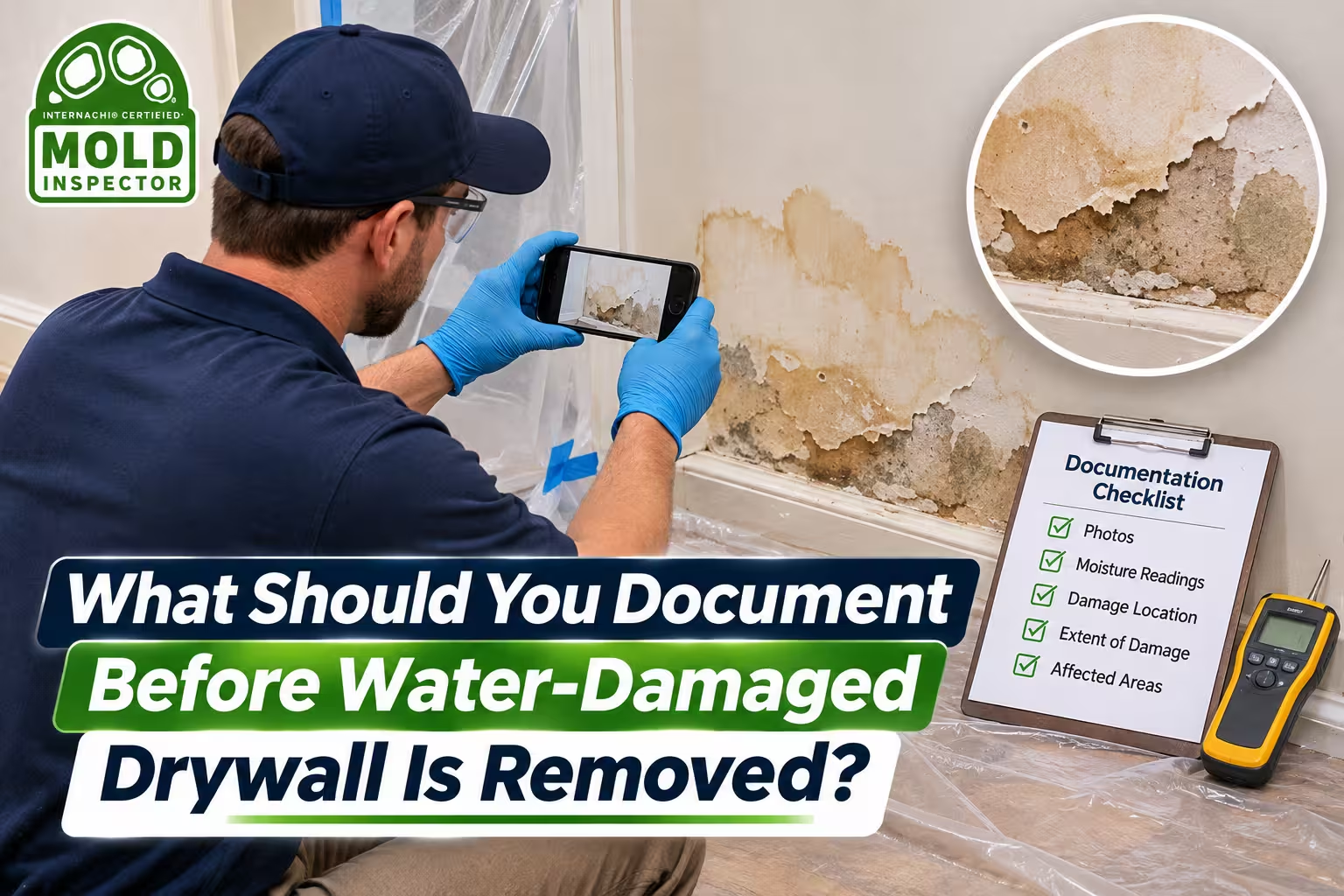
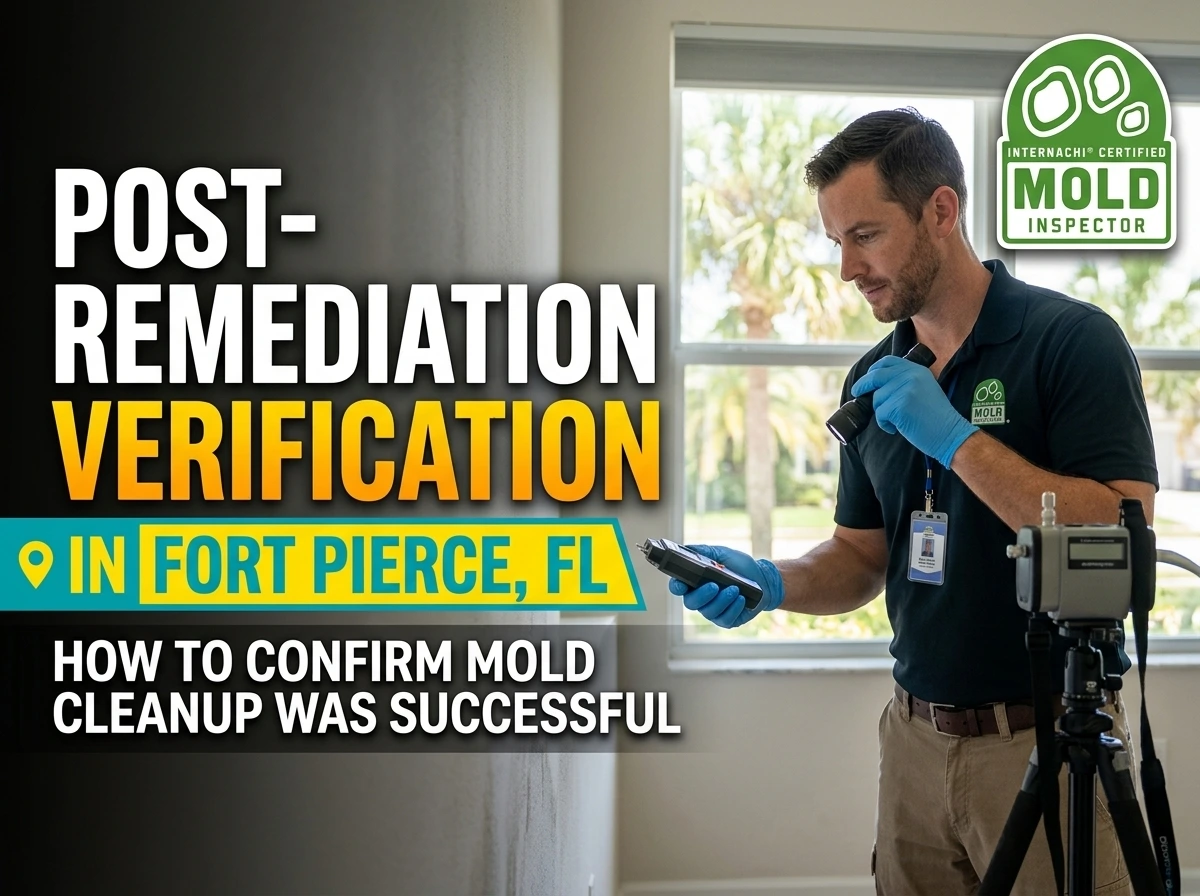
- Visual re-inspection. This covers walls, ceilings, drywall, flooring, cabinets, and any HVAC system components or crawl space areas that were part of the job. The assessor looks for remaining growth, staining, residue, odor, and signs the containment was breached.
- Moisture assessment. A moisture meter checks whether materials are dry, and the assessor looks for any ongoing source such as a slow leak, condensation, or a drainage problem.
- Air sampling, where warranted. Indoor samples are compared with an outdoor sample taken at the same time, because outdoor air is the natural baseline.
- Surface sampling, where needed. Tape lifts or swabs can confirm whether a cleaned surface is truly clear.
- Laboratory analysis and report. Samples go to a lab, and the assessor documents findings in a written inspection report: what was inspected, what was measured, what the lab found, and whether the remediation goals appear to have been achieved.
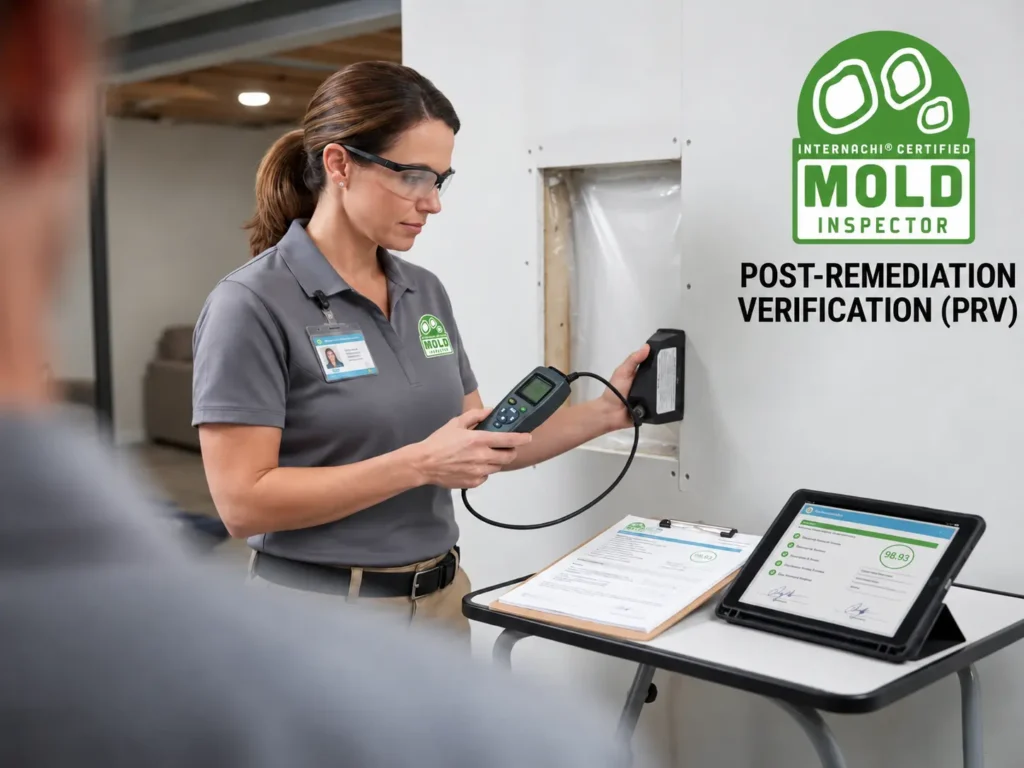
post-remediation verification follows this same outline: a visual re-inspection, air and surface sampling when needed, certified laboratory analysis, and a written report with recommendations.
Before the Visit: Moisture Source and Timing
Verification only works if the job it’s verifying was done properly. Two things matter most before the assessor arrives.
First, the moisture source has to be fixed. A repaired pipe, a dried assembly, a corrected drainage path, or a serviced air conditioning system is what keeps mold from coming back. Cleanup without that step is just a reset.
Second, the timing. Verification usually follows once cleanup and drying are finished, often a day or two later, though some protocols sample before containment comes down. Your assessor or remediation protocol will specify the window. Rebuilding first and testing later defeats the purpose, since drywall and finishes will cover the areas the assessor needs to see.
When a remediation project is large or involves insurance, having someone independent watch the work as it happens helps catch problems early. This is what mitigation and remediation monitoring is for, and it often makes the final verification smoother.
Reading the Results: Pass, Fail, and What Comes Next
There’s no single universal number that defines a passing result. Indoor air samples are generally compared with the outdoor reference, looking at both the amount and the types of spores. Indoor results that are similar to or lower than outdoors, with no signs of water-damage-associated fungi, point toward a successful cleanup. Weather, humidity, and air movement all affect spore counts, which is why interpretation is the assessor’s job and not a matter of reading a chart yourself.
A solid report should include the visual findings with photos, the moisture readings and where they were taken, the lab results with the sampling locations, the outdoor comparison, and a plain statement of whether the work passed. If a report only lists numbers with no conclusion, ask for one.
Treat the written conclusion as a whole picture. A passing air sample alongside visible growth, a musty smell, or damp materials is not a pass.
If the result is not acceptable, the usual next step is for the remediation contractor to re-clean the flagged area, address whatever was missed, and then have it checked again. Who pays for the return visit depends on your contract, so read it before the job starts, not after.
Fort Pierce Conditions Worth Knowing
Fort Pierce sits on the Atlantic coast of St. Lucie County, where warm, humid weather and the June through November hurricane season make water intrusion and lingering dampness a recurring concern. After a storm leak, a roof problem, or an air conditioning failure, mold can reestablish if materials don’t dry thoroughly. That’s why moisture readings carry so much weight in a local verification, and why a clean-looking room isn’t enough evidence on its own. Hidden spaces deserve extra attention in this climate, including crawl spaces, attic edges, and the areas around air handlers and ducts, because dampness there can go unnoticed for weeks.
Humid outdoor air also raises the baseline you’re compared against, which is another reason to insist on a same-day outdoor sample. For more on how the local climate affects growth, see this Fort Pierce climate and mold growth guide.
Questions to Ask Before You Hire
- Are you a licensed Florida mold assessor, and what’s your license number?
- Do you or your company have any relationship with the remediation contractor?
- Will you take an outdoor comparison sample, and which lab do you use?
- What will the report include, and will it state a clear conclusion?
- What happens if the result isn’t acceptable?
- How is the price set? Cost depends on factors such as property size, number of areas, number of samples, and lab fees, so ask for a written quote.
Mold Detectives Florida provides mold testing and inspection services across the Treasure Coast and other Florida areas, so those questions are fair to put to any provider you compare.
Questions Homeowners Ask About Verification
Can I move back in or rebuild before I get the results?
It’s safest to wait for the assessor’s written conclusion. Once drywall and finishes go back up, the areas that needed checking are hidden, and fixing a failed result gets more expensive.
Does passing mean mold can’t come back?
No. It means conditions met the goals on the day of the visit. Long-term protection depends on controlling moisture, so fix leaks quickly, keep indoor humidity in check, and have the air conditioning serviced.
How long do lab results take?
It depends on the lab and the options you choose, so ask for the expected turnaround when you book. Don’t rebuild until the final report is in.
Next Steps After a Mold Cleanup in Fort Pierce
Confirm the moisture source is fixed, hold off on rebuilding, and bring in an independent assessor to document the result. That sequence protects your home, your insurance position, and your money. If you’ve just finished a cleanup and want it verified, contact the Mold Detectives or call (772) 242-4024.