
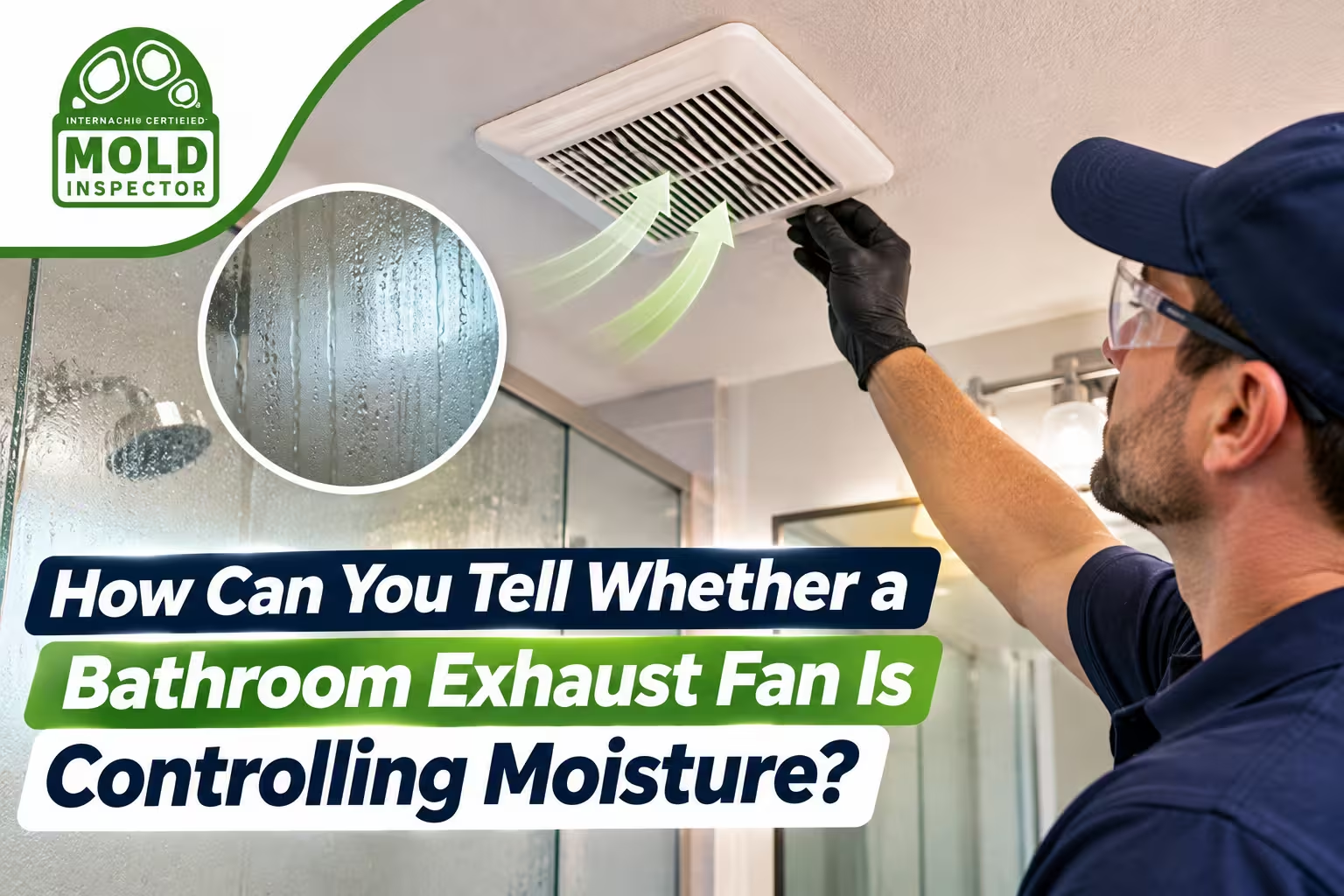
A bathroom fan can sound powerful yet leave the room damp long after a shower. Mirrors stay fogged, water collects on the ceiling, or paint begins to deteriorate near the shower. Because the motor is running, homeowners may assume ventilation is working correctly. Unfortunately, noise and visible rotation do not establish how much moisture is actually leaving the bathroom.
Bathroom exhaust fan moisture problems become easier to recognize when you compare humidity before and after showering, observe how long condensation remains, and check whether the fan exhausts outdoors. Poor airflow can result from clogged grilles, restrictive ductwork, undersized equipment, or inadequate replacement air. Persistent dampness can also come from a leak that a bathroom fan cannot correct.
What Does an Effective Bathroom Exhaust Fan Actually Do?
An exhaust fan pulls humid bathroom air into a duct and sends it outside. As that air leaves, replacement air enters from adjoining rooms through an appropriate pathway. The process reduces the moisture load created by showers and baths, but it does not instantly dry every wet surface. Water left on tiles, grout, and shower doors still needs time to evaporate or be removed directly.
A correctly working fan should help the room return toward its usual humidity after bathing. The best evidence is a consistent pattern: condensation gradually clears, the air feels less damp, and moisture does not repeatedly accumulate in distant corners. There is no single mirror-clearing time that proves adequate ventilation, because shower temperature, room size, surfaces, and outdoor conditions all influence the result.
Which Warning Signs Suggest Poor Bathroom Ventilation?
Condensation during a hot shower is normal. What deserves attention is moisture that repeatedly lingers long after use, especially on surfaces outside the shower enclosure. Persistent droplets on ceilings, peeling finish near an exhaust grille, or dampness along painted wall corners can indicate that humidity is not being removed effectively. A recurring musty odor may signal another moisture problem, although smell alone does not prove mold growth.
How Can a Hygrometer Help You Test Moisture Removal?
A digital hygrometer measures relative humidity, which describes how much water vapor air holds compared with its capacity at the current temperature. The Environmental Protection Agency recommends indoor humidity below 60 percent, ideally between 30 and 50 percent. Those figures are general moisture-control guidance, not a pass-or-fail bathroom test while somebody is showering. A temporary spike is expected when hot water releases steam into the room.
Record humidity before a shower, immediately afterward, and again after the fan has operated for another 20 minutes. Repeat this on several similar days, placing the hygrometer away from direct spray. Look for readings that reliably decline toward the room’s earlier level. If they remain elevated, check the fan and other potential moisture sources. Humidity readings reflect both ventilation and household conditions, so they cannot diagnose a faulty fan on their own.
Why Does a Fan Run Without Removing Enough Moisture?
Dust and Obstructions at the Grille
Dust and lint can accumulate around the intake grille and restrict the amount of air reaching the fan. With the power off, homeowners can visually inspect accessible surfaces and follow manufacturer instructions for basic cleaning. A tissue held near the grille may show that air is moving, but it cannot tell you whether the installed system meets its required airflow. Actual performance needs an appropriate measurement by a qualified technician.
Duct Restrictions or the Wrong Termination
A fan can appear functional while a crushed duct, excessive bends, or an obstructed exterior vent limits the airflow leaving the building. Poorly connected ductwork can also release humid air into an attic or ceiling cavity. The U.S. Department of Energy advises that bathroom fans should discharge outdoors rather than into enclosed building spaces. Inaccessible ducts and exterior outlets should be evaluated safely by an HVAC or ventilation professional.
Not Enough Replacement Air
When the bathroom fan removes air, an equivalent amount must enter the room. A tightly sealed door without a suitable transfer path can restrict this replacement airflow, even if the motor and duct are in good condition. The Home Ventilating Institute recommends allowing makeup air to pass beneath bathroom doors. That does not mean every door should be cut immediately; a contractor can determine whether airflow restrictions actually exist before recommending modifications.
Is the Bathroom Fan Large Enough for the Room?
Fan capacity is measured in cubic feet per minute, or CFM. The Home Ventilating Institute generally recommends approximately one CFM per square foot for bathrooms up to 100 square feet, with additional guidance for larger bathrooms. For instance, an 80-square-foot bathroom commonly calls for about 80 CFM of rated exhaust capacity. Some building standards also specify minimum intermittent or continuous exhaust rates, so local requirements and the room’s design should be considered.
The number printed on a fan is its rating under specified test conditions, not necessarily the airflow delivered after installation. A long, narrow, or heavily bent duct can reduce real-world performance. Choosing a higher-rated fan without addressing a restrictive duct may not solve the problem. A ventilation technician can measure delivered airflow and compare it with the intended design before recommending equipment replacement.
How Long Should You Leave the Fan Running?
The Home Ventilating Institute recommends leaving a bathroom exhaust fan on for about 20 minutes after use. Operating it during the shower and allowing it to continue afterward gives humid air a route outside while steam is being produced and as the room begins drying. Timer switches can help avoid shutting the fan off too soon, while suitable humidity-sensing controls may provide automatic operation.
Twenty minutes is a useful starting point, not a guarantee that every bathroom will return to normal moisture conditions within that period. Long showers, high starting humidity, or poor airflow may change the outcome. If moisture consistently remains elevated despite adequate operating time, investigate actual airflow rather than simply running the fan longer every day. The underlying problem may be ductwork, equipment capacity, or moisture entering from another source.
What Can You Check Before Calling a Ventilation Contractor?
Begin with observations that do not require removing electrical covers or entering an attic. Confirm that the fan is switched on during bathing, inspect the visible grille for dust, and note whether the bathroom door is closed when humidity persists. Where safely accessible, look for an exterior termination that may be blocked or damaged. Record humidity readings and photograph recurring condensation to help explain the problem to a technician.
When Is a Leak More Likely Than an Exhaust Problem?
A bathroom fan removes humid air, but it cannot stop water entering through damaged shower waterproofing, leaking plumbing, or a failed window detail. Dampness that persists when the shower has not been used, or staining concentrated around one fixture, may point toward a concealed leak. If materials feel soft or stains spread after the plumbing is used, the priority is identifying the water source rather than increasing ventilation.
For moisture that appears to be entering a wall, floor, or ceiling, professional leak detection can help investigate concealed water pathways. Mold Detectives describes the use of moisture meters and thermal imaging in its published service information. Those methods help locate areas requiring further investigation, but an unusual thermal pattern alone cannot prove that a surface contains mold or that a particular pipe is leaking.
When Should Persistent Dampness Lead to a Mold Inspection?
Repeated condensation can support mold growth if moisture remains on suitable materials. However, a damp smell or dark spot is not enough to establish the type or extent of contamination. The EPA emphasizes fixing moisture problems and evaluating visible growth rather than assuming every situation requires routine air sampling. Where stains recur, drywall deteriorates, or hidden moisture is suspected, an assessment can help identify which building materials are affected.
If moisture remains after ventilation problems have been corrected, the next step is to determine whether the surrounding walls, ceiling, or other materials have absorbed water. A professional inspection can help identify damp areas and assess the extent of possible mold growth. Air sampling is not always necessary, particularly when visible growth is already present. The priority should be identifying the moisture source and evaluating affected materials before deciding what corrective work is required.
Why Does This Matter for Bathrooms in Fort Pierce?
In Fort Pierce, Florida, warm and humid outdoor conditions can complicate attempts to dry bathrooms by simply opening windows. Depending on the weather, outdoor air may introduce more moisture into an air-conditioned home. A properly ducted exhaust fan provides a controlled path for bathroom humidity to leave, while the home’s cooling and dehumidification systems help manage background moisture. Local conditions make monitoring actual indoor humidity more useful than relying on how the air feels.
Frequently Asked Questions
Does a Foggy Mirror Mean My Bathroom Fan Is Too Weak?
Not necessarily. A hot shower can fog a cooler mirror even when the exhaust system is working. A better indication is whether condensation steadily clears and the overall room humidity falls after showering. If moisture stays on ceilings and painted walls for extended periods despite continued fan operation, ask a qualified technician to measure exhaust airflow and inspect the duct before deciding the fan itself needs replacement.
Can an Exhaust Fan Work With the Bathroom Door Closed?
Yes, as long as enough replacement air can enter the room. Many bathrooms have a suitable transfer gap below the door or another designed pathway. A very tight door may restrict airflow, but the correct solution depends on the existing layout. If the fan seems less effective only when the door is shut, tell the ventilation technician; that observation may help direct the assessment.
Should a Bathroom Fan Run All Day to Prevent Mold?
Continuous ventilation can be appropriate in a system designed for that operating mode, but an ordinary intermittent fan should not automatically be left on all day. The correct schedule depends on airflow capacity, controls, household use, and the ventilation design. Persistent moisture after normal operation is a reason to assess the system, not proof that continuously running the motor will address hidden leaks or damp materials.
Know When the Moisture Problem Needs More Than a Fan Adjustment
A bathroom exhaust fan should help humidity return toward normal levels and carry damp air outdoors, but a running motor alone does not prove adequate ventilation. Track moisture patterns, confirm airflow with a qualified technician when necessary, and investigate persistent dampness that could indicate concealed water damage. If moisture or possible mold remains a concern after the ventilation issue is identified, contact Mold Detectives or call (772) 242-4024 to discuss an inspection.